American Football
05.10.2026
Smart Money, Live Sports: How IPTV Fits a Self-Directed IRA Investor's Strategy in the United States
If you manage your own retirement account, you already know the golden rule of self-directed investing: every dollar that leaves your wallet is a dollar that never compounds. You track fees, you hunt for yield, and you scrutinize every expense that eats into your capital. Yet one of the biggest silent leaks in most household budgets is entertainment — specifically the cable bill that quietly drains $100 to $200 every single month.
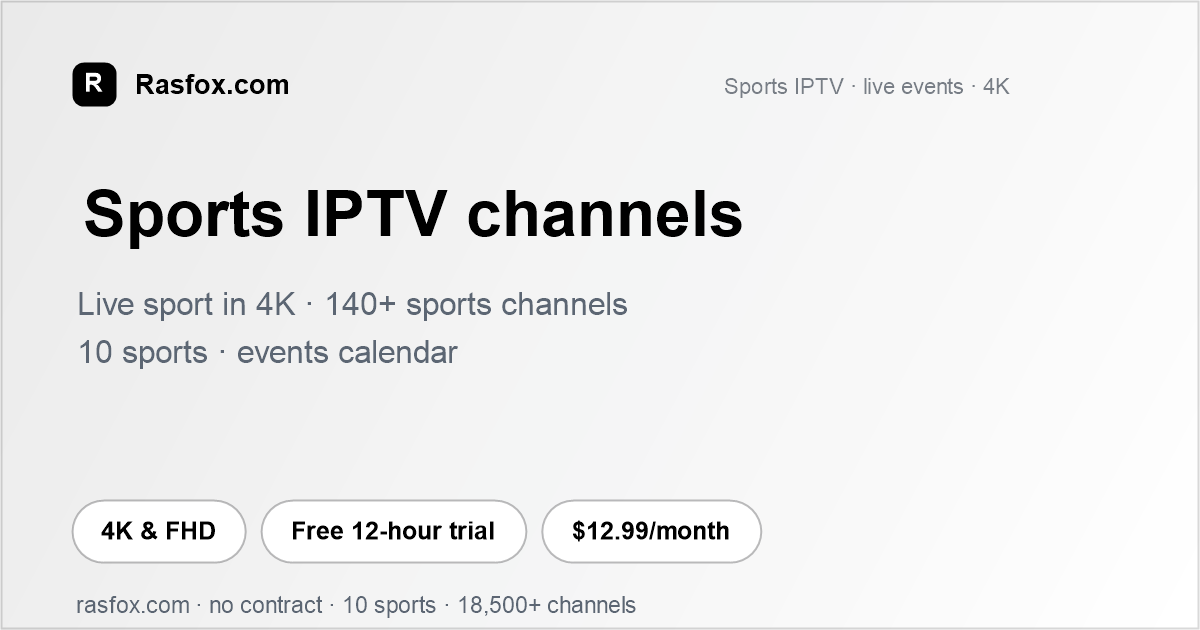
That is exactly where IPTV enters the picture. Internet Protocol Television is not just a cheaper way to watch live TV — for the self-directed investor, it is a cash-flow reallocation tool. Cut the legacy cable package, switch to a sports-focused IPTV service, and suddenly you have hundreds of extra dollars a year to pour into real estate notes, private equity, crypto, or a Roth IRA. And you still get every match, every fight, and every race in stunning 4K.
This guide explores how IPTV works, why the United States is one of the fastest-growing IPTV markets in the world, and how a sports-first provider like RasFox IPTV fits neatly into the financial philosophy of anyone who prefers to control their own retirement destiny.
What Is IPTV — and Why Should a Retirement Investor Care?
IPTV stands for Internet Protocol Television. Instead of receiving channels through coaxial cable or a satellite dish, your programming arrives over your existing internet connection. The practical result: thousands of channels, huge on-demand libraries, and picture quality that often surpasses traditional cable — all delivered without a contract, a dish, or a two-year lock-in.
The financial angle is what matters most for the self-directed audience. Traditional cable and satellite providers in the US bundle equipment rental fees, regional sports network surcharges, broadcast fees, and "mystery" taxes onto a base price that already looked expensive. IPTV providers strip that structure away. You pay one flat rate, you keep your hardware, and you cancel whenever you want.
Here is what a modern premium IPTV subscription typically delivers:
- 12,000+ live channels from the US, Latin America, Europe, and Asia
- 40,000+ video-on-demand titles in 4K quality
- 4K at 50 FPS for live sports — the frame rate that makes fast motion look smooth
- Two simultaneous screens so a spouse or family member can watch something else
- No buffering on a stable connection, with anti-freeze servers
- No contract and no equipment rental
- 24-hour free trial so you can test before committing
- Portuguese and Spanish support alongside English assistance
For someone analyzing return on investment, the math is brutally simple: replace a $120 cable bill with a $15–$25 IPTV plan, and you have freed up roughly $1,200–$1,400 per year. Invested at a 7% average annual return over 20 years, that single reallocation is worth tens of thousands of dollars. That is the kind of compounding most people never think about because it hides inside their entertainment budget.
The Thematic Bridge: How IPTV Enhances Your Self-Directed IRA Strategy
A self-directed IRA is built on the principle that you, not a fund manager, decide where your money goes. The same philosophy applies to your household expenses — you decide which subscriptions deserve a line item and which ones get eliminated.
Cut the Cable, Fund the Account
Most investors obsess over expense ratios of 0.5% while ignoring a cable package that costs more than a monthly IRA contribution. Switching to IPTV converts a depreciating expense into investable capital. If you contribute the savings to a self-directed IRA, that money can be deployed into alternative assets that traditional custodians simply will not allow.
Ready to run the numbers for yourself? You can start a 24-hour free IPTV trial and compare the total cost against your current cable invoice — no contract, no risk, no sales pressure.
Financial News and Market Coverage in the Same Interface
Self-directed investors need information, not just entertainment. An IPTV lineup that includes CNBC, Bloomberg, Fox Business, and international financial networks keeps you connected to market-moving headlines without adding a second streaming subscription. It is one platform, one bill, one remote.
Passive-Asset Thinking Applied to Entertainment
You already understand the difference between an asset that appreciates and a liability that depreciates. A cable contract with an early termination fee is a liability. A flexible, month-to-month IPTV plan, by contrast, behaves like a variable expense you can scale up or down at will — the same flexibility you demand from your retirement portfolio.
Deep Dive: The IPTV Landscape in the United States
The United States is one of the most dynamic IPTV markets on the planet. Broadband penetration is high, fiber rollout is accelerating, and cord-cutting has gone mainstream — millions of households have already abandoned traditional cable. What most people still lack, however, is a legitimate, well-organized, sports-first option.
That is the gap RasFox IPTV was built to fill. The service traces its roots to Radio Malena 89.1 FM in Buenos Aires (Venezuela 370), a station steeped in tango and Argentine cultural tradition. Today, that same broadcaster heritage has evolved into a global IPTV platform serving lusophone and Latino communities worldwide — with a total focus on sports channels and live sports events.
For viewers in the United States, the channel list is deliberately built around sport, not filler:
- US & worldwide sports: ESPN, DAZN, Fox Sports, beIN Sports, Sky Sports, Eurosport
- Latin & South American coverage: TyC Sports, ESPN Premium, TNT Sports Argentina, Fox Sports, DirecTV Sports
- Brazilian football: Globo, SporTV, Premiere, ESPN Brasil, BandSports, Combate, TNT Sports BR
- Portuguese football: Sport TV 1–6, Eleven Sports, Benfica TV, Porto Canal, DAZN Portugal
- African sports: SuperSport, Sport TV Africa, ESPN Africa
Competition coverage is where sports-focused IPTV truly separates itself from generic streaming bundles. Depending on the season and package, viewers can follow the Brasileirão, Copa Libertadores, Champions League, Liga Portugal, Liga Argentina, La Liga, Premier League, Formula 1, and UFC — often in 4K at 50 FPS, which makes a fast counter-attack or an F1 overtake look the way it should.
If your household includes both English- and Spanish-speaking sports fans, that dual coverage is a genuine money saver. You are not paying for two separate services to keep everyone in the family happy.
Hardware and Setup Guide for Self-Directed Investors
One reason IPTV appeals to financially disciplined households is the near-zero equipment cost. You are almost certainly not buying a satellite dish or renting a cable box. Here is what you actually need:
1. A Stable Internet Connection
A minimum of 25 Mbps is comfortable for HD streaming; 50 Mbps or higher is recommended for 4K multi-screen setups. Most American fiber and cable broadband plans already exceed this comfortably.
2. A Streaming Device
- Amazon Fire TV Stick — the most popular and affordable option
- Android TV box or Nvidia Shield — best performance for 4K 50 FPS sports
- Smart TV apps — Samsung, LG, and Android-based sets work well
- Apple TV — excellent for users already inside the Apple ecosystem
3. An IPTV Player App
Your provider supplies the playlist or login credentials; a compatible player app handles the interface. Setup usually takes under ten minutes — far less time than waiting on hold with a cable company's retention department.
4. Ethernet When Possible
Wi-Fi is convenient, but a wired connection eliminates the micro-lag that ruins live sports. If your streaming device sits near your router, plug it in. This one small change is the difference between a flawless match and a frustrating one.
For investors who value simplicity, this is a setup you configure once and then largely forget — no installation appointment windows, no annual equipment upgrades, no surprise line items. You can explore RasFox IPTV packages and see exactly what your monthly outlay looks like before you commit a single dollar.
Legal vs. Illegal IPTV: Safety, Compliance, and Best Practices
This is the section most articles avoid, and it matters far more to a self-directed investor than to the average viewer. If you are managing a retirement account, you cannot afford legal exposure, payment disputes, or a compromised device sitting on the same network as your financial logins.
The technology of IPTV is entirely legal. What separates a legitimate provider from a pirate operation is licensing and distribution rights. The warning signs of a shady service are consistent:
- Prices that are implausibly low (a few dollars for everything, forever)
- No company information, no terms of service, no identifiable ownership
- Payment only via untraceable methods, with no refund policy
- No trial period, or a trial that demands a credit card with no way to cancel
- Constant buffering, dead channels, and disappearing support
Best practices for protecting yourself and your household:
- Use a reputable, transparent provider with published terms and real customer support.
- Pay with a method that gives you recourse — avoid sending untraceable payments to unknown parties.
- Keep financial activity on a separate network or VLAN if your router supports it. Good digital hygiene is non-negotiable when your retirement accounts live online.
- Test before you commit. A legitimate provider will happily let you evaluate the service first.
- Keep records. If you ever claim a home-office or business expense, clean documentation matters.
RasFox IPTV is positioned as a safe, sports-first recommended solution: transparent pricing, no contract, a genuine 24-hour free trial, and multilingual support in Portuguese, Spanish, and English. For an investor who treats due diligence as a core skill, that transparency is the deciding factor. You can review the service directly at the official RasFox IPTV site.
Frequently Asked Questions About IPTV and Self-Directed IRAs
Is IPTV legal in the United States?
Yes — IPTV is a legal distribution technology. Legality depends on whether the provider holds the appropriate distribution rights for the content it streams. Choosing a transparent, reputable provider with clear terms is the practical way to stay on the right side of the line.
How much can I actually save by switching from cable to IPTV?
Most US households save between $80 and $150 per month after removing equipment rental, regional sports fees, and broadcast surcharges. Redirected into a self-directed IRA over 20 years, that savings can grow into a five-figure sum through compounding alone.
Can I watch live football and other sports in 4K with RasFox IPTV?
Yes. The platform is built with a total focus on sports, offering 12,000+ channels and 40,000+ VOD titles, with live events delivered in 4K at 50 FPS and anti-freeze servers designed to eliminate buffering.
Do I need expensive hardware to get started?
No. A $30–$50 streaming stick, a stable internet connection of at least 25 Mbps, and a compatible player app are enough. Many smart TVs already support IPTV apps natively, so additional hardware may not be necessary at all.
How many screens can I use at once?
RasFox IPTV supports two simultaneous screens, which means one household member can watch a Premier League match while another follows the Brasileirão or a UFC card — without paying for a second subscription.
Is there a free trial?
Yes. A 24-hour free trial lets you test channel stability, 4K quality, and sports coverage before spending anything. There is no contract, so you are never locked in.
Conclusion: Spend Less on Screens, More on Assets
Self-directed investing is fundamentally about refusing to hand over control — of your money, your strategy, or your future. Your entertainment spending deserves the same scrutiny. A cable package with hidden fees and a two-year commitment is the financial equivalent of an underperforming fund with a high expense ratio.
IPTV flips that equation. For a fraction of the cost, you get 12,000+ channels, 40,000+ on-demand titles in 4K, two simultaneous screens, zero buffering, no contract, and a sports lineup built with genuine obsession — from the Champions League and Premier League to the Libertadores, Brasileirão, Formula 1, and UFC. Backed by a broadcasting heritage that began at Radio Malena 89.1 FM in Buenos Aires and now serves lusophone and Latino audiences worldwide, it is a service designed by people who actually care about live sport.
Your next step: take the 24-hour free trial, compare the total cost against your current cable bill, and calculate what that difference looks like invested over 20 years. Then put the savings to work in your self-directed IRA — where it belongs.
Start your free 24-hour trial of the best sports-focused IPTV service today →